

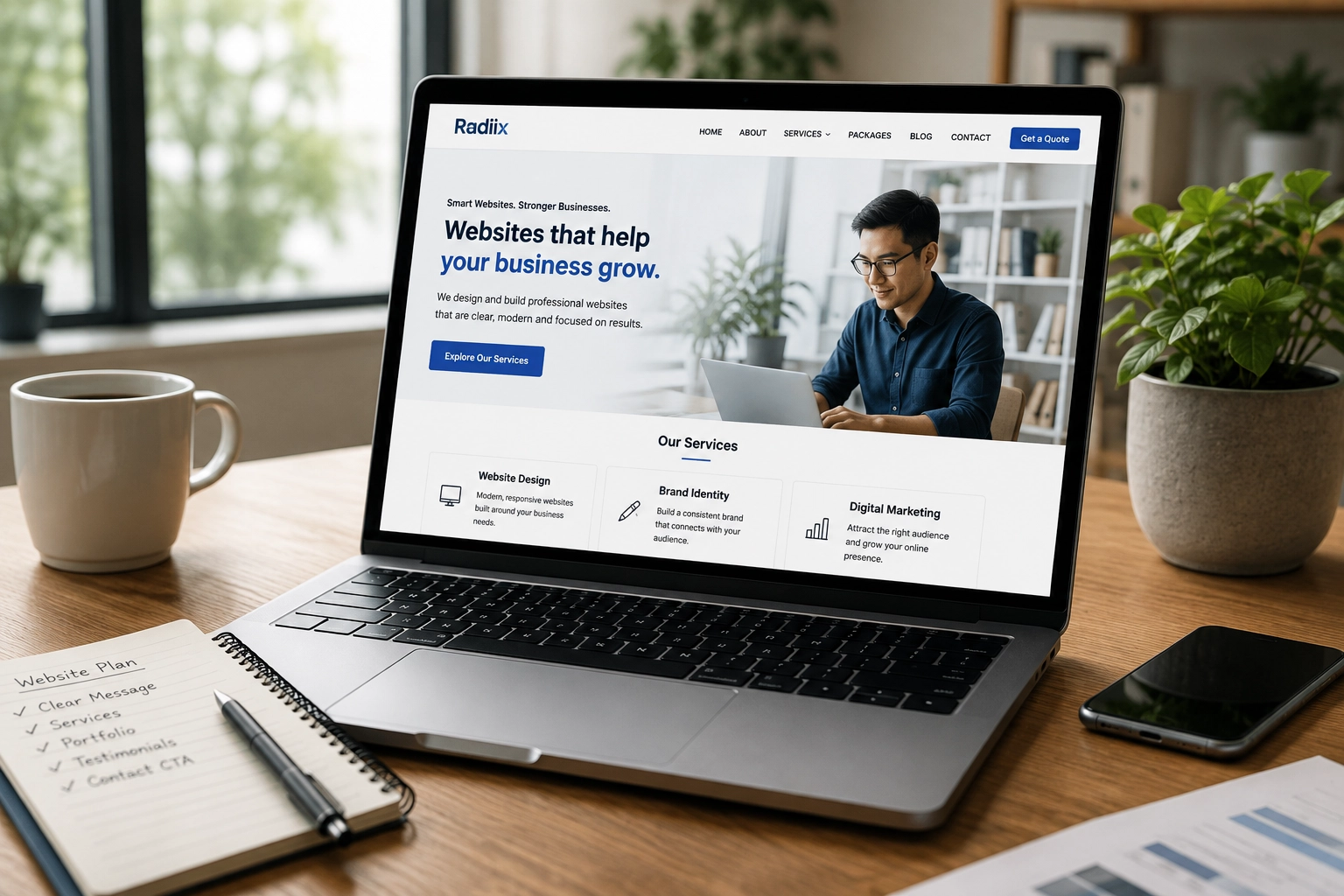
A small business website should do more than look professional.
It should help visitors understand what your business offers, decide whether it is relevant to them and take the next step with confidence.
For many customers, your website may be the first proper introduction to your business. They may arrive through Google, an advertisement, social media, a referral or your business profile. What they see next can influence whether they continue exploring or leave.
A useful website therefore needs to support real business goals, not simply fill a space online.
What is a small business website really for?
A business website acts as a central place where potential customers can learn about your company, services and ways to contact you.
Unlike a social media profile, your website gives you greater control over how your business is presented. You decide what information appears, how your services are organised and what action visitors are encouraged to take.
A good website should connect your business information, brand, marketing and customer journey in one clear place.
Explain what your business does
Visitors should be able to understand your business quickly.
Your homepage should clearly communicate:
- What you provide
- Who you serve
- Where you operate
- What makes your approach relevant
- What visitors should do next
Avoid making customers search through several pages before understanding your offer.
Clear communication is usually more valuable than clever wording.
Help the right people recognise that you can help
A website should not attempt to appeal to everyone.
It should speak clearly to the customers your business is best positioned to serve.
This means using examples, services, language and information that reflect the needs of your intended audience.
When visitors recognise their situation in your website, they are more likely to continue reading and consider contacting you.
Build confidence in your business
Before making an enquiry, customers often look for signs that a business is credible and dependable.
Your website can build confidence through:
- Clear company information
- Well-presented services
- Consistent branding
- Real project examples
- Testimonials or reviews
- Accurate contact details
- Professional writing
- Transparent processes
Trust is rarely created by one dramatic statement. It is built through many small signals working together.
Make your services easy to understand
A list of service names is not always enough.
Each important service should explain:
- What it includes
- Who it is suitable for
- What outcome it supports
- How the process works
- What the customer can do next
Visitors should not need technical knowledge to understand your offer.
The clearer your services are, the easier it becomes for someone to decide whether to enquire.
Guide visitors towards the next step
Every important page should provide a clear next action.
Depending on the business, this could be:
- Sending a WhatsApp message
- Completing an enquiry form
- Calling the company
- Requesting a quotation
- Booking a consultation
- Viewing packages
- Exploring related services
The next step should be easy to find without overwhelming the visitor with too many competing buttons.
A website should guide, not chase.
Support your marketing activities
Your website should work together with your wider marketing.
Someone may discover your business through:
- Google Search
- Google Ads
- Meta Ads
- TikTok
- YouTube
- Google Business Profile
- Social media
- Referrals
The website becomes the place where that initial attention is converted into deeper understanding and possible action.
Without a clear website, marketing may generate traffic but fail to turn that interest into meaningful enquiries.
Work properly across mobile and desktop
Many visitors will view your website on a mobile phone.
A professional website should therefore:
- Load quickly
- Use readable text
- Keep buttons easy to tap
- Avoid cramped layouts
- Display images correctly
- Make contact options easy to access
- Maintain a clear hierarchy on smaller screens
Mobile design should not feel like a compressed desktop page. It should remain simple and usable in its own right.
What a small business website does not need
A useful business website does not always need:
- Complicated animations
- Large amounts of text
- Dozens of pages
- Every available feature
- Trendy effects that distract from the message
- Technical language customers do not understand
The right website depends on the business.
Some companies may only need a focused one-page website. Others may require separate service pages, project galleries, forms, integrations or ongoing content.
The goal is not to build the biggest website. It is to build the right website for the business.
A practical website checklist
Before launching or improving your website, ask:
- Can visitors understand the business quickly?
- Are the main services clearly explained?
- Is the website easy to use on mobile?
- Are the contact options visible?
- Does the design feel consistent with the brand?
- Is the information current and accurate?
- Does each important page guide visitors towards a next step?
- Can the website support future marketing activities?
If several answers are unclear, the website may need better structure rather than simply more decoration.
A small business website should help people understand, trust and engage with your business.
Conclusion
It should present your services clearly, support your marketing and make the next step easy.
The strongest websites are not necessarily the most complicated. They are the ones that connect business goals, customer needs and clear communication in a practical structure.
Planning a business website?
Radiix helps startups, independent professionals and growing businesses create clear, professional websites built around real business needs.
Explore our Website Design services
View Website Packages
Talk to Radiix on WhatsApp