

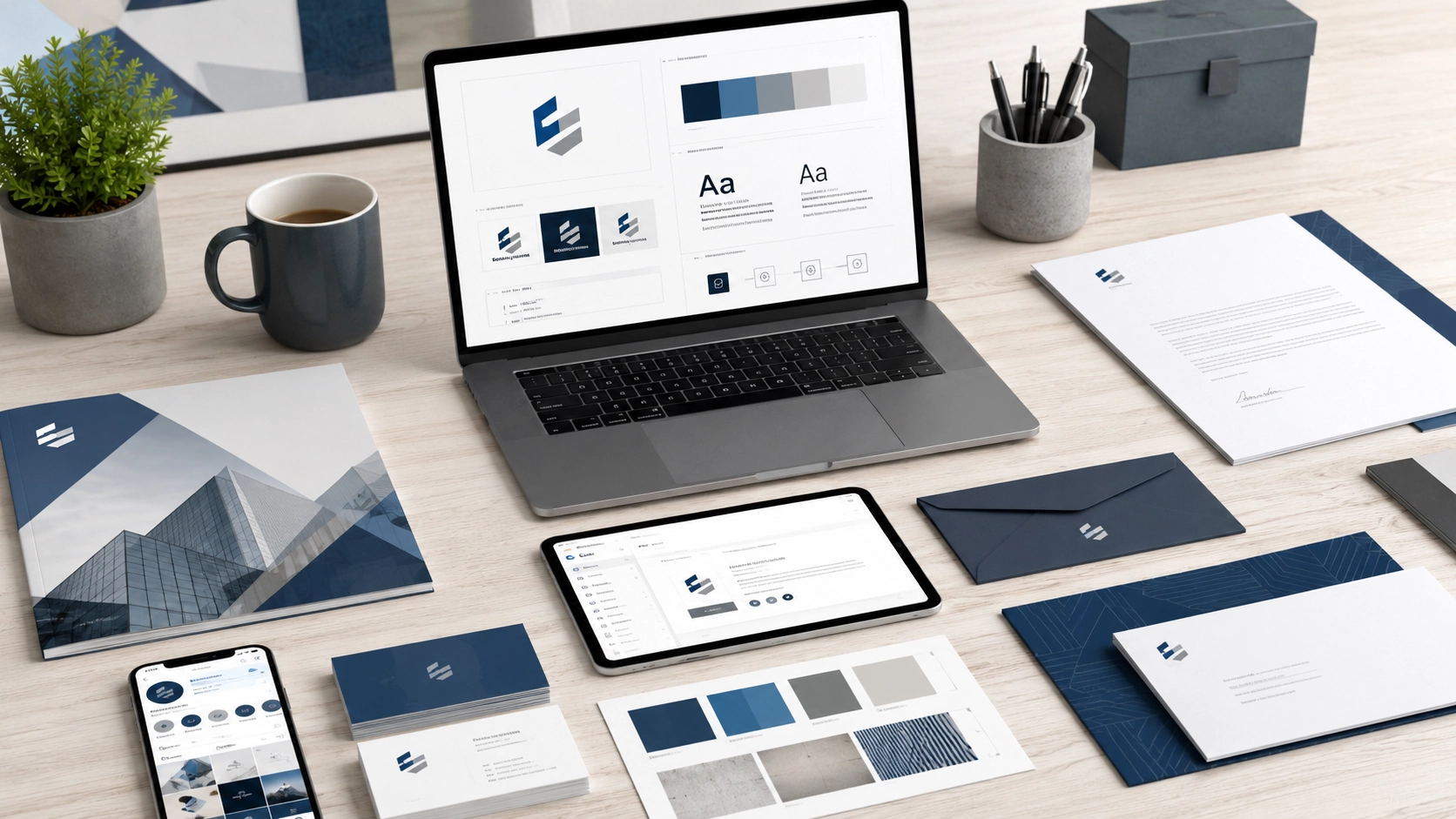
Starting a new business involves more than choosing a name and creating a logo.
The business also needs practical materials that help it present itself consistently across websites, documents, social media, proposals, signage and customer communication.
These materials form the working layer of the brand.
Some businesses need only a small set of essentials to begin. Others require a broader system because they operate across more platforms, work with multiple suppliers or need to appear established from launch.
The goal is not to produce every possible branded item.
It is to create the materials the business actually needs to operate clearly and confidently.
What are branding materials?
Branding materials are the visual and communication assets used to represent a business.
They help customers recognise the business and understand that different touchpoints belong to the same company.
Branding materials may be used across:
- Websites
- Social media
- Presentations
- Proposals
- Name cards
- Letterheads
- Packaging
- Signage
- Advertisements
- Company profiles
- Email communication
- Internal documents
When these materials follow one visual system, the business appears more consistent and organised.
The essential foundation
Before creating stationery, brochures or digital templates, the business needs a clear visual foundation.
This usually includes:
- A primary logo
- Supporting logo variations
- Brand colours
- Typography
- Basic usage rules
These elements guide everything that comes afterward.
Without them, each new item may be designed differently, which can weaken recognition and create unnecessary rework.
Logo variations
A single logo file is rarely enough for everyday use.
A practical logo system may include:
Primary logo
The main version used across most applications.
Secondary logo
An alternative layout for narrow, tall or compact spaces.
Brand mark
A simplified symbol or icon used for profile pictures, favicons, packaging or small applications.
Monochrome version
A black, white or single-colour version for situations where the full-colour logo is unsuitable.
Reversed version
A logo designed to appear clearly on dark backgrounds.
The business should receive suitable file formats for both digital and print use.
This may include:
- PNG
- JPG
- SVG
- AI or EPS source files
Different formats support different applications, so one low-resolution image is not enough.
Brand colours
A colour palette helps the business remain visually consistent.
It may include:
- Primary colours
- Secondary colours
- Neutral colours
- Accent colours
- Background colours
The palette should be practical enough to work across:
- Websites
- Social media
- Printed materials
- Presentations
- Signage
- Advertisements
Colour values should be recorded clearly.
Common formats include:
- HEX for websites
- RGB for digital use
- CMYK for print
- Pantone where exact colour matching is important
A good palette provides flexibility without creating too many competing colours.
Typography
Typography affects how the brand feels and how easy its materials are to read.
A basic typography system may include:
- Heading font
- Body font
- Supporting font
- Font weights
- Size guidance
- Spacing guidance
The selected fonts should work across the platforms the business uses.
A highly distinctive font may look good in a logo but may not be practical for long paragraphs, documents or websites.
The system should balance personality with readability.
Business stationery
Stationery helps the business present itself professionally in everyday communication.
Depending on the business, this may include:
Name cards
Useful for meetings, networking, site visits and referrals.
Letterhead
Provides a consistent format for formal correspondence.
Envelope
May be useful for businesses that send physical documents.
Quotation template
Helps proposals and pricing documents look consistent.
Invoice template
Keeps billing documents aligned with the brand.
Receipt or delivery-order template
Relevant for retail, service or logistics businesses.
Presentation template
Useful for sales meetings, proposals and internal communication.
Not every business needs every item immediately.
The priority should be based on how the business actually operates.
Digital brand assets
Most businesses now need a set of digital assets from the beginning.
These may include:
Website favicon
The small icon displayed in browser tabs and bookmarks.
Social media profile image
A simplified logo or brand mark suitable for a circular or square crop.
Social media cover image
A branded banner for platforms such as Facebook, LinkedIn or YouTube.
Email signature
A consistent format for names, titles, contact details and links.
Digital presentation cover
A reusable opening slide for proposals or company presentations.
Video-call background
Useful for businesses that regularly conduct online meetings.
Document header and footer
Keeps digital files visually connected to the brand.
These materials help the business appear consistent even before it invests in larger campaigns.
Marketing materials
Marketing materials help the business explain its offer and promote its services.
Common examples include:
Brochure
A short overview of the company, services and contact details.
Company profile
A more detailed document covering the business, capabilities, experience and services.
Flyer
Useful for promotions, events, direct distribution or local marketing.
Service sheet
A focused document explaining one service or package.
Social media templates
Reusable formats for announcements, promotions, educational posts and updates.
Advertisement templates
Layouts designed for digital campaign use.
Presentation deck
Useful for proposals, partnerships, sales meetings and investor discussions.
The business does not need every marketing asset at launch.
It should begin with the materials most likely to support real sales activity.
Operational brand materials
Branding is not only for outward-facing marketing.
It can also improve everyday business operations.
Operational materials may include:
- Quotation templates
- Proposal templates
- Invoice formats
- Service reports
- Checklists
- Work-order forms
- Staff uniforms
- Vehicle decals
- Site signage
- Packaging labels
- Customer handover documents
These items help the business look more organised and reduce the need to recreate materials repeatedly.
For service businesses, operational documents may be among the most frequently used brand assets.
What a new business may not need immediately
New businesses sometimes create too many materials before they know what customers actually need.
Items that may not be necessary at the beginning include:
- Large brand manuals
- Multiple brochure versions
- Extensive packaging systems
- Complex illustration libraries
- Large template collections
- Printed materials that may quickly become outdated
- Promotional items with no clear use
- Many logo variations with no practical purpose
It is usually better to build the brand in stages.
Start with the materials needed to operate, communicate and sell.
Expand when the business has clearer processes, channels and customer demand.
How to prioritise branding materials
A practical way to prioritise is to group materials into three levels.
Level 1: Essential for launch
These are the assets most businesses need immediately:
- Primary logo
- Secondary logo
- Brand mark
- Colour palette
- Typography
- Basic brand guide
- Website favicon
- Social media profile image
- Email signature
Level 2: Essential for business operations
These depend on how the company works:
- Name card
- Letterhead
- Quotation template
- Invoice template
- Proposal cover
- Presentation template
- Service documents
Level 3: Growth and marketing materials
These support sales and expansion:
- Company profile
- Brochure
- Flyers
- Social media templates
- Campaign graphics
- Signage
- Packaging
- Vehicle graphics
This approach helps the business avoid unnecessary spending while still building a consistent system.
A practical branding checklist
Before finalising the brand materials, ask:
- Is the logo available in the right formats?
- Can the logo work on light and dark backgrounds?
- Are the brand colours clearly documented?
- Are the fonts practical and accessible?
- Is there a favicon?
- Are social media profile assets ready?
- Is the email signature consistent?
- Are quotation and proposal templates prepared?
- Can different suppliers follow the brand direction?
- Are print files suitable for production?
- Are digital files organised and easy to find?
- Does every item feel like part of the same business?
If several answers are unclear, the business may need a more complete brand system.
Conclusion
A new business does not need every possible branding material from the beginning.
It needs the right materials to operate, communicate and present itself consistently.
The foundation usually begins with a usable logo system, brand colours, typography and basic guidelines.
From there, the business can add stationery, digital assets, marketing materials and operational documents based on real needs.
A practical brand system should make business easier.
It should help different materials look connected, reduce repeated design work and give the company a clearer presence as it grows.
Building a practical brand system?
Radiix helps startups, independent professionals and growing businesses create brand identities and materials prepared for real business use.
Explore Brand Identity & Design
View Brand Packages
Explore Copywriting & Content Creation
Talk to Radiix on WhatsApp