

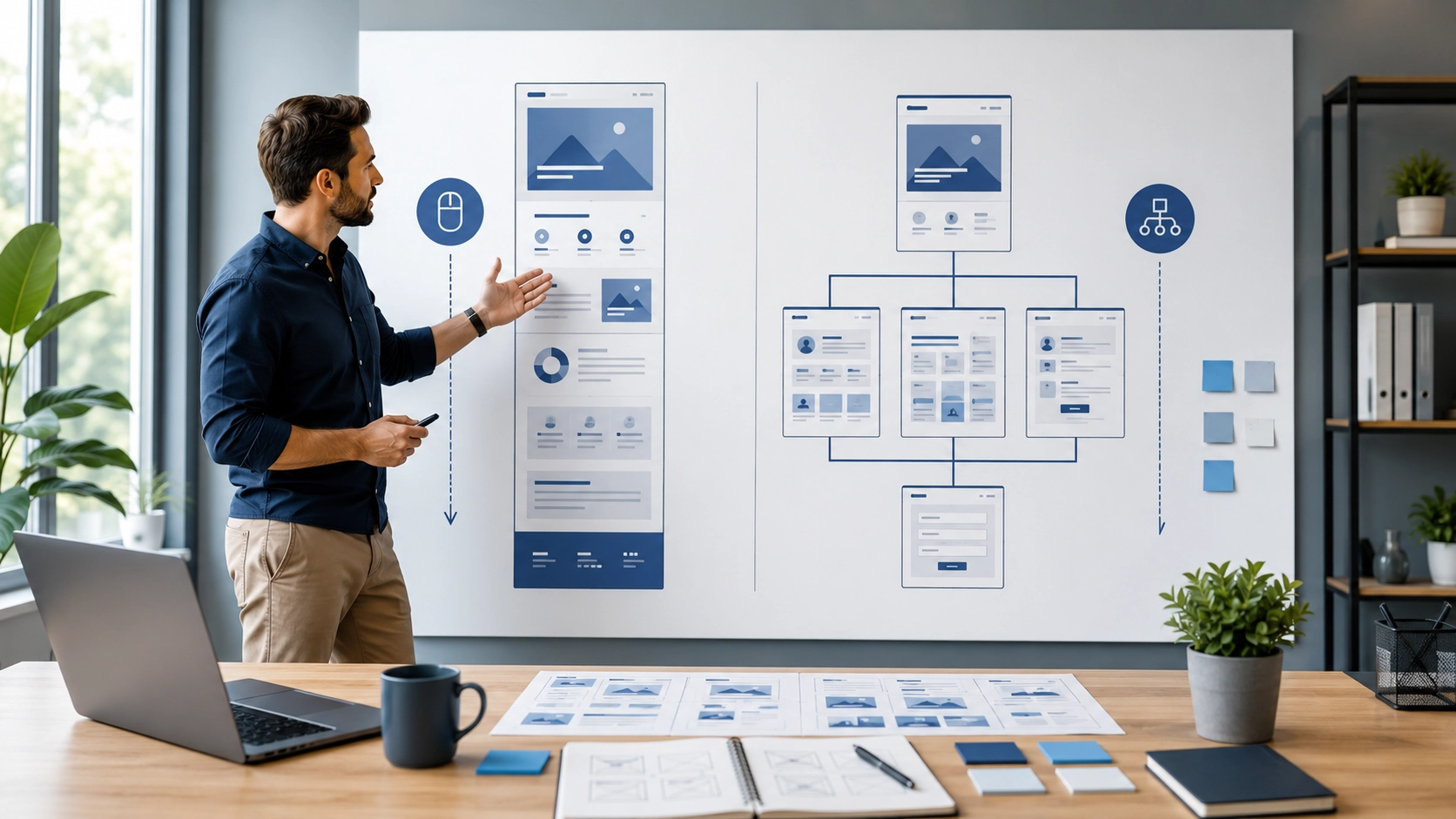
A business website can be built as one long scrolling page or as a larger structure with several separate pages.
Both approaches can work.
The right choice depends on how much information the business needs to present, how many services it offers, how customers search and what the website is expected to achieve.
A one-page website may provide focus and simplicity.
A multi-page website may provide more room for services, content, marketing and future growth.
The decision should be based on business needs rather than appearance alone.
What is a one-page website?
A one-page website places the main business information on one continuous page.
Visitors move through the content by scrolling instead of opening several separate pages.
A typical one-page website may include:
- Hero section
- Business introduction
- Service overview
- Key benefits
- Process
- Testimonials
- Frequently asked questions
- Contact details
- Enquiry form
- Calls to action
The navigation menu may still appear at the top, but the links usually move visitors to different sections on the same page.
This format is often used by new businesses, independent professionals, single-service providers and focused campaigns.
What is a multi-page website?
A multi-page website separates information into individual pages.
A typical structure may include:
- Homepage
- About page
- Services page
- Individual service pages
- Packages page
- Portfolio or project page
- Blog
- Contact page
- Legal pages
Each page has its own purpose and can explore one subject in greater detail.
This format is often more suitable for businesses with several services, more information or long-term plans for digital marketing and SEO.
The main difference between the two
The main difference is how the information is organised.
A one-page website presents the main journey in one continuous flow.
A multi-page website divides the journey across several pages.
This affects:
- Content depth
- Navigation
- Search visibility
- Advertising
- Future expansion
- User experience
- Website maintenance
A one-page site asks:
What is the most important information visitors need?
A multi-page site asks:
How should different subjects be separated and connected?
Neither structure is automatically better.
The right structure is the one that helps visitors understand the business without creating unnecessary complexity.
Advantages of a one-page website
A one-page website can offer several practical benefits.
Simple navigation
Visitors can move through the main information without opening many pages.
This can create a clear and focused experience.
Faster to plan
A one-page website usually requires less content and a simpler structure.
This may reduce planning and production time.
Lower initial cost
Because the scope is smaller, a one-page website may be more affordable than a larger multi-page website.
Clear customer journey
The business can guide visitors through one planned sequence:
- Understand the business
- Review the services
- Build confidence
- Take action
Suitable for focused offers
A one-page structure can work well when the business has:
- One main service
- One target audience
- One clear call to action
- Limited supporting information
Easier maintenance
There are fewer pages to review, update and maintain.
Limitations of a one-page website
A one-page website also has constraints.
Limited content space
It may become difficult to explain several services properly without making the page too long.
Weaker page targeting
The website has fewer individual pages that can target specific search topics.
Less suitable for complex businesses
Businesses with many services, audiences or locations may struggle to fit everything into one clear flow.
Difficult future expansion
New services, packages or resources may eventually require separate pages.
Navigation can become crowded
A long page with many sections may feel difficult to scan.
Less room for detailed trust-building
Case studies, FAQs, project examples and service details may need to be shortened.
A one-page site works best when the business can remain focused.
Advantages of a multi-page website
A multi-page website provides more room and flexibility.
Clear service separation
Each important service can have its own page.
This helps visitors find more relevant information.
Better content depth
The business can explain:
- What the service includes
- Who it is for
- How the process works
- What outcomes it supports
- What the next step should be
Stronger SEO potential
Separate pages can focus on different topics, services and search terms.
Better advertising support
Advertisements can direct visitors to a page designed specifically for the relevant offer.
Easier future growth
New services, packages, articles and projects can be added without rebuilding the entire website structure.
Improved internal linking
Pages can guide visitors towards related services, resources and contact options.
More professional depth
A larger structure can help established businesses present more information without overcrowding the homepage.
Limitations of a multi-page website
A multi-page website also requires more effort.
Higher cost
More pages usually require more planning, design, writing and development.
More content preparation
The business needs enough useful information for each page.
Longer project timeline
A larger structure takes more time to organise and complete.
Greater maintenance
More pages need to be reviewed and updated.
Risk of duplication
Poor planning may cause the same message to appear repeatedly across several pages.
More complex navigation
The menu structure needs to remain clear, especially when there are many services.
A multi-page site should create more clarity, not more corridors.
One-page vs multi-page website comparison
| Area | One-Page Website | Multi-Page Website |
|---|---|---|
| Structure | One continuous page | Several individual pages |
| Best suited for | Simple or focused businesses | Businesses with more services or content |
| Initial cost | Usually lower | Usually higher |
| Project timeline | Often shorter | Often longer |
| Content depth | Limited | Greater |
| SEO flexibility | More limited | Stronger |
| Advertising support | Suitable for focused campaigns | Better for multiple services |
| Future expansion | More restricted | Easier |
| Maintenance | Simpler | More involved |
| Navigation | Straightforward | Requires clear hierarchy |
The comparison should guide the decision, not replace proper planning.
Which businesses suit a one-page website?
A one-page website may suit:
- New startups
- Independent professionals
- Freelancers
- Consultants
- Single-service businesses
- Small local businesses
- Temporary campaigns
- Events
- Simple product launches
- Businesses testing a new offer
It may also be suitable when the business mainly receives customers through referrals and only needs a professional place to confirm its services and contact details.
The key condition is focus.
If the business can explain itself clearly on one page, the format may be enough.
Which businesses suit a multi-page website?
A multi-page website may suit:
- Businesses with several services
- Companies serving different customer groups
- Growing SMEs
- Businesses using SEO
- Companies running several advertising campaigns
- Professional service firms
- Renovation and construction businesses
- Agencies
- E-commerce companies
- Businesses with projects, case studies or resources
The format is also useful when each service needs its own explanation, examples and call to action.
A multi-page structure gives the website more room to grow with the business.
What about SEO and advertising?
The website structure can affect both SEO and paid campaigns.
SEO
A multi-page website usually provides more opportunities to target different search topics.
For example, a company may have separate pages for:
- Website design
- Branding
- Google Ads
- SEO
- Content creation
Each page can focus on one subject and answer related questions.
A one-page website can still appear in search results, but it has fewer opportunities to target several distinct topics clearly.
Advertising
A one-page website can work well as a focused landing page for one campaign.
A multi-page website is more useful when the business advertises several services.
Each campaign can direct visitors to the most relevant page.
The strongest advertising structure usually matches the campaign message with the page content.
Can a one-page website grow later?
Yes.
A one-page website can be a practical starting point.
As the business grows, it may add:
- Separate service pages
- About page
- Packages page
- Case studies
- Blog
- Contact page
- Landing pages
The original one-page site may gradually become the homepage of a larger website.
However, this is easier when the first site is built with future expansion in mind.
The website should use a platform, structure and hosting setup that can support additional pages later.
A low-cost website that cannot expand may need to be rebuilt entirely.
Questions to ask before choosing
Before deciding, ask:
How many services does the business offer?
One focused service may suit one page.
Several important services may require separate pages.
How much explanation does each service need?
A simple offer may only need a short section.
A complex service may need a full page.
Will the business use SEO?
If several search topics matter, a multi-page structure may be more suitable.
Will the business run advertising?
Separate landing pages can improve relevance for different campaigns.
How quickly does the website need to launch?
A one-page website may be faster to complete.
What budget is available?
A smaller scope may be more practical at the beginning.
Is the business likely to grow?
Future services, locations and content may need a broader structure.
Can the business prepare enough content?
A multi-page website should not be filled with repeated or weak information.
Conclusion
One-page and multi-page websites can both support a business effectively.
A one-page website offers simplicity, focus and a lower entry point.
A multi-page website provides more room for services, content, SEO, advertising and future growth.
The right choice depends on the complexity of the business and the role the website needs to play.
A smaller website is not necessarily weaker.
A larger website is not necessarily better.
The best structure is the one that gives customers enough information, keeps the journey clear and supports the business without unnecessary complexity.
Choosing the right website structure?
Radiix helps startups, independent professionals and growing businesses plan websites around their services, customers and business goals.
Explore Website Design
View Website Packages
Explore SEO Services
Talk to Radiix on WhatsApp